No products in the cart.
Return To Shop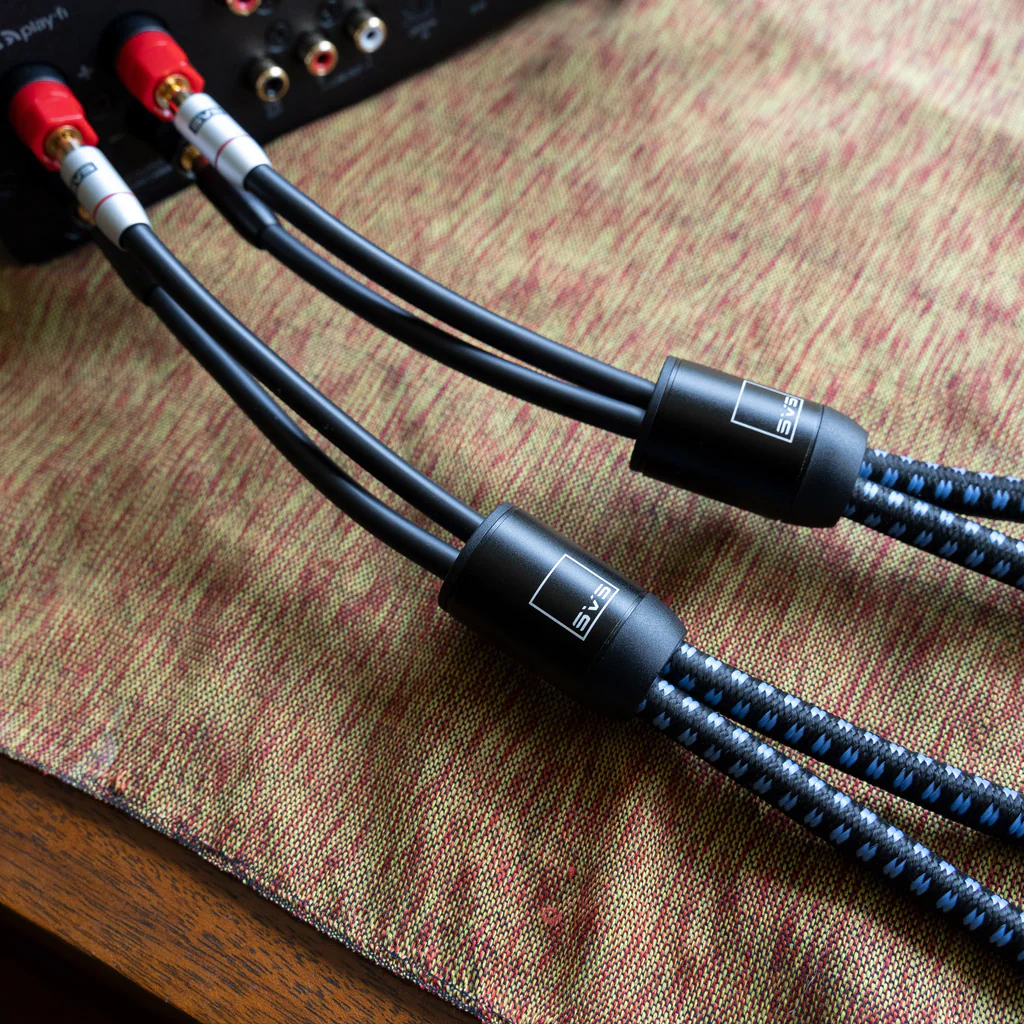
What is speaker Bi-Wiring? .
Audiophiles and home theater fans who want to get the best possible performance from their systems have countless options, ranging from replacing the front-end amplifier for tens of thousands of dollars to adjusting speaker placement and AV receiver settings at absolutely no cost. But hey, that’s what makes this hobby so much fun, right?
One option if you use speakers with two sets of connections is bi-wiring. While this does not guarantee a dramatic improvement in sound quality, there are benefits and the upgrade is relatively inexpensive. Let’s take a closer look to understand if bi-wiring speakers are right for you.
What is a bi-wire (two-wire) speaker cable?
A two-wire speaker cable is an enhanced speaker cable used to connect one amplifier channel to a speaker with two sets of connections. Unlike a standard speaker cable, which has a total of two conductors (one positive and one negative), a two-wire cable has four conductors divided into two pairs of positive and negative conductors on the speaker side. This design is intended to create separate paths for each of the two sets of speaker terminals, separated for high-frequency and low-frequency audio signals.
What are the advantages of bi-wiring speakers?
Bi-wiring has two primary advantages. The first is to reduce the cable impedance by 50%. Any wire, no matter how good of material and design, acts as a resistor and impedes current flow, albeit to a very small degree. A properly designed bi-wire cable uses twice as much cable compared to the same length of standard speaker cable, reducing the already small impedance by half. This results in a stronger current to the speaker and greater potential dynamic impact.
Second, there is a property of loudspeakers called intermodulation distortion or IMD. With this feature, a very small portion of the distortion is essentially passed backward through the crossover and then to other drivers. Typically, this is more likely to be passed from the woofer channel to the high-frequency channels. This effect is incredibly small and although measurable, rarely audible.
A two-wire cable makes this effect much less likely, because the IMD from the woofer channel can no longer pass through the sweater cable, but instead must pass through both full lengths of the two-wire cable. Although the cable is made of low impedance materials, the end-to-end length of the two-wire cable will hinder the effect of IMD from the woofer channel. This can result in better separation between the high, mid and low based on a signal with lower distortion being passed to all channels of the speaker.
While bi-wiring may not dramatically improve a speaker system in a noticeable way, it is an extra step that listeners can take in their pursuit of sonic perfection.
How do I wire my speakers?
To bi-wire speakers, you need a compatible speaker with two sets of connections, an AV receiver or amplifier, and bi-wire speaker cables. It is critical to remove any continuity ties between the speaker terminals. It is also best to use cables of the same length and of the same brand/model.
The amplifier side of the two-wire speaker cable has only two terminals, positive and negative, which are connected to the appropriate positive and negative terminals on the receiver or amplifier channel. The speaker side of the two-wire cable has four connectors, divided into two pairs. One pair goes to the upper terminals of the speaker, while the second pair goes to the lower terminals. This allows the high and low frequency drivers in the speaker to be connected separately. If your equipment and speakers do not support bi-wiring, you can just use standard speaker cable.
This is a loose copy of the original English SVS article, “What is Speaker Bi-Wiring?“