No products in the cart.
Return To Shop
Subwoofer calibration & tuning: getting the bass just right.
 A well-designed powered subwoofer adds a whole new dimension to any home theater or stereo system by harnessing the depth of low frequencies found in movie soundtracks and music recordings. Huge explosions, roaring engines and droning musical bass lines create a sense of content, and when unleashed with the help of a properly calibrated subwoofer, it creates a level of immersion that simply cannot be replicated, even with full-range speakers.
When setting up a subwoofer, it is critical to balance the low frequencies with the rest of the speakers. Huge, heart-pounding bass can be a lot of fun, but it should not sound boomy and bloated, not drowning out or toning down the rest of the soundstage just when the content demands it most.
A properly calibrated subwoofer is accurate in the frequencies it plays, and its output blends seamlessly with the speakers so that it sounds like the bass is coming from each individual speaker rather than from a specific point in the room. The subwoofer should not draw attention to itself, but allow sounds to be heard and felt naturally and make the listening experience more exciting and immersive.
Subwoofer calibration and adjustment is an important step in making sure your home audio system sounds its best. The process differs a bit depending on whether you are setting up a multichannel home theater or a two-channel stereo system, so we have described the steps for both below.
Subwoofer calibration for home theater systems.
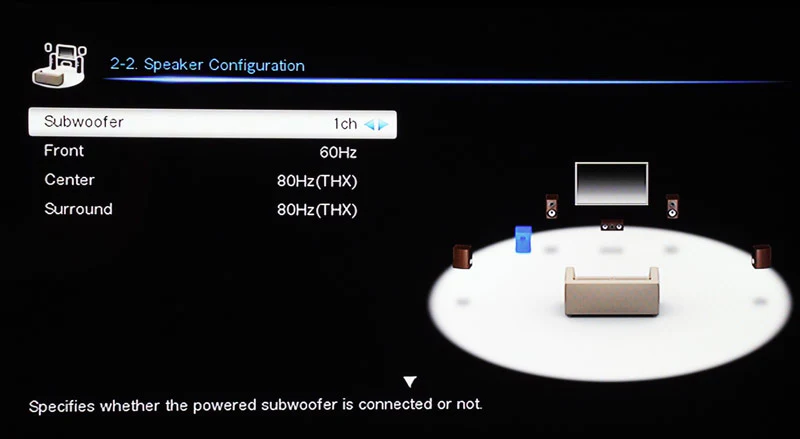 We start with a home theater system with an AV receiver or preamplifier/processor with a dedicated subwoofer or LFE output connected to the subwoofer input. We also assume that the subwoofer is powered, that is, it has a built-in amplifier, and that it is located where it will remain permanently.
- Does the sub have an analog or digital volume control?
- If it is an analog knob with a dial, set it to the middle of the range. This is usually at the 12 or 1 o’clock position.
- If it is digital (the control may be in a manufacturer’s app), start halfway down the range as well. For SVS subwoofers with digital volume control, start at a setting of -15.
- These settings give the AV receiver or pre/pro enough leeway to set the final sub level correctly during the automatic setup routine.
- Most subwoofers also have controls for phase and low-pass filter (or LPF).
- Set phase to 0.
- Set the LPF to the highest frequency or off. If the LPF control is a rotary knob, turn it all the way to the right, which may have “LFE” on it. If the LPF controller is digital, turn it off completely.
- Start the autocalibration process in the AV receiver or pre-pro, which will play test tones from each speaker and the subwoofer and adjust the levels accordingly. We always recommend performing the chamber calibration before performing the fine adjustment.
- After the process is complete, look at the subwoofer level in the AV receiver or pre/pro.
- In Denon, Marantz and Onkyo AVRs, this value ranges from -12 to +12; in Pioneer and Yamaha AVRs, it is between -10 and +10.
- Did the AVR automatically set the subwoofer level to the lowest value?
- If so, turn down the subwoofer’s built-in level control and run the automatic setup routine again. Repeat until the automatic subwoofer level in the AVR or pre/pro is not the lowest possible value.
- This ensures that the volume of the subwoofer is correct as far as the automatic setup routine is concerned.
- Look at the bass management settings in the AVR or pre/pro, particularly whether or not the automatic setup routine identified one of the main speakers as “large.”
- Make sure all main speakers are set to “small” so that the low frequencies in all the main channels are redirected to the sub, which is much better at reproducing those low frequencies than almost any main speaker.
- Once all main speakers are set to “small,” set the crossover for each speaker, which determines the point at which low frequencies are redirected to the subwoofer.
- This depends on the make and model of each speaker. Set the crossover to 10-15 Hz above the measured or specified low frequency extension of the speaker. For example, if the bass extension of the speaker is 50 Hz (-3 dB), the crossover for that speaker should be set to 60-65 Hz.
- Play some of your favorite material, including songs with lots of deep bass.
- How does it sound to you? Is the bass well integrated with the rest of the speakers and the room? Does it seem to lack impact? If you want a little more, try increasing the level by 2-4 dB. But be careful; if you increase even more, the bass will likely drown out the rest of the soundstage.
- If you want to increase the level of the subwoofer, do you do it in the AVR or on the sub itself?
- If the sub has an analog rotary volume control, adjust the level in the AVR, which offers more precise and repeatable settings.
- If the sub has digital level control, it doesn’t matter where you make the adjustment.
Subwoofer calibration for two-channel stereo systems
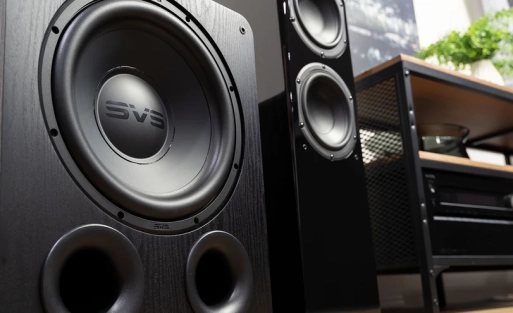
SVS 2.1 System
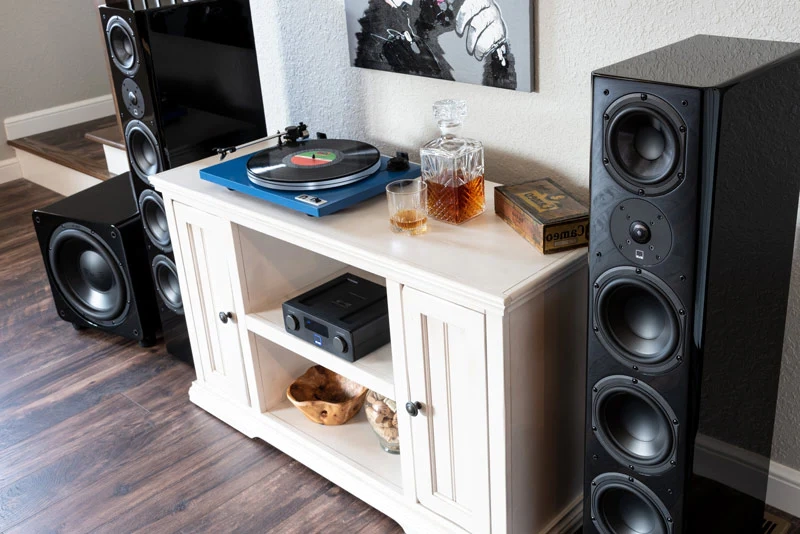 For those who enjoy two-channel audio, a subwoofer (or two) is often a great improvement when added to the two main speakers. In this case, there is no bass management, no time alignment and no automatic level adjustment. The main speakers receive a full-range signal from the electronics, and the preamp usually does not provide a separate subwoofer output.
- If the preamplifier has dual outputs, connect one set to the power amplifier and the other set to the subwoofer(s).
- If the preamplifier has only one pair of outputs, use “Y” splitters to send the signal to the power amplifier and subwoofer(s) from the same outputs.
- Find the low-frequency extension of your main speakers, that is, the -3 dB point on the low end.
- Ideally, you can find this in the manufacturer’s specifications on the website or in the product’s manual; otherwise, you can sometimes find measurements in reviews from reputable media.
- Set the cutoff frequency of the subwoofer’s internal low-pass filter to the same value as the bass extension of the main speaker.
- For example, if the bass extension of the speaker is 45 Hz (-3 dB), set the LPF of the subwoofer to 45 Hz.
- Some subwoofers, such as those from SVS, also offer a control that adjusts the slope of the LPF above the cutoff point, which helps tremendously in integrating the subwoofer(s) with the main speakers.
- If the speakers are ported, their cutoff frequency is 24 dB/octave; if they are sealed, their cutoff frequency is 12 dB/octave.
- Adjust the cutoff frequency of the subwoofer to that of the speakers.
- Play some favorite music and adjust the subwoofer level by ear until it sounds just right – mixing, not dominating.
- You can also play with the LPF cutoff setting of the subwoofer, perhaps by increasing it slightly so that it overlaps with the main speakers. But beware; if you have too much overlap, you will get a unison, droning bass and possibly phase problems.
- If your main speakers do not have deep low frequencies – say somewhere in the 50 to 80 Hz range – it is a good idea to have two subwoofers, which give you stereo bass. To learn more about the benefits of multiple subwoofers, read this article:
Why dual subwoofers?
- On the other hand, if your speakers reach as low as 30 Hz or so, a single subwoofer is fine, since frequencies that low are not directional.
Bassheads beware – don’t overdo it
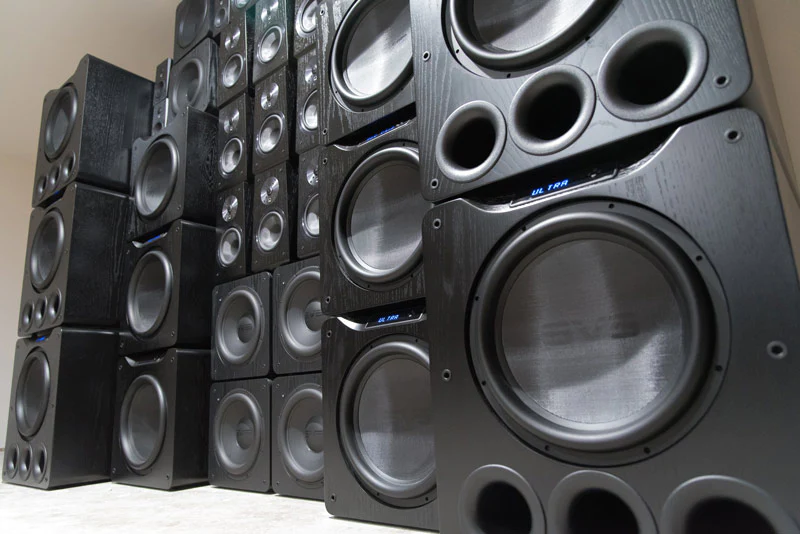 Many audio enthusiasts love to turn the bass up so loud that the roof tiles shake. But that’s like a constant diet of sweets – it feels good for a while, but it’s eventually exhausting. Nor is it how the content creator intended it to sound.
This is completely analogous to video calibration. Many people watch their video display in so-called “vivid” or “torch mode,” which looks very bright and wildly colorful, but it is tiring on the eyes and not what the content creator intended you to see. A calibrated video display may look dull at first, but it is much more natural and once most viewers get used to it, they cannot go back to torch mode.
Similarly, a presentation with too much bass is not an accurate representation of what the artist had in mind; in fact, it can be quite distracting. The goal of any audio system is to immerse listeners in the content so that they forget about the speakers and subwoofers and simply enjoy the experience. If you follow the recommended procedures for calibrating your sub, we’re sure you’ll come to appreciate the accuracy of balanced bass so you can lose yourself in your favorite music and movies for hours.
This is a loose copy of the original English SVS article: “Subwoofer Calibration & Tuning: Getting the Bass Just Right“